

5G networks are increasingly deployed as cloud-native platforms, enabling network functions to run consistently across central data centers, regional sites, and the far edge. This distributed model supports autonomous edge architectures, where traffic can be processed locally and essential services maintained even when connectivity to the central network is disrupted.
Supporting distributed 5G Standalone (SA) and Non-Standalone (NSA) environments requires more than cloud-native network functions (CNFs). The 5G core and its underlying platform must support distributed deployment, automated lifecycle management, resilience, and predictable scaling, while maintaining operational consistency across sites.
AxyomCore provides a cloud-native 5G core designed to run on Red Hat OpenShift, the industry's leading hybrid cloud application platform powered by Kubernetes. Its network functions have been validated, qualified and deployed in production on Red Hat OpenShift. This horizontal approach allows Telenor to run critical 5G control-plane and user-plane functions consistently from the core to the far edge. AxyomCore has also demonstrated these 5G core functions using Red Hat OpenShift on Google Cloud and Amazon Web Services, giving telecommunications service providers flexibility in where and how they deploy the mobile core.
Use case: Autonomous Edge
Mobile core networks have been designed around centralized control-plane and user-plane functions. While effective in many environments, this model can create resilience challenges when remote sites depend on backhaul connectivity to reach the central core.
In remote communities, industrial sites, public safety environments, and other hard-to-reach locations, outages caused by storms, fiber cuts, or extreme geography can interrupt the voice, data, and operational services on which people and organizations depend.
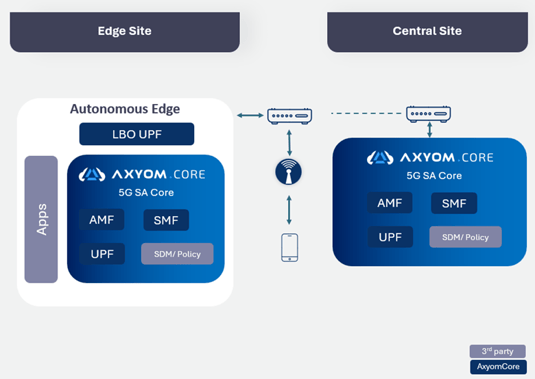
During normal operation, subscriber data, policies and configurations are synchronized between the two sites. If the backhaul connection is disrupted, the edge core automatically takes over, allowing the site to continue operating as a local autonomous 5G network without manual intervention.
Red Hat OpenShift provides the common platform layer for running AxyomCore’s CNFs across the central and edge environments. Its automation and lifecycle-management capabilities simplify how service providers deploy and manage services consistently across distributed sites, especially in locations where local resources and operational support may be limited.
AxyomCore’s edge-ready 5G core supports:
-
Local service continuity during network isolation
-
A local User Plane Function (UPF) with local breakout
-
Low-latency access to local applications and services
-
Autonomous operation during backhaul outages
-
Deployment in environments with limited space and resources
-
Mission-critical and edge-based use cases
The local UPF is particularly important for latency-sensitive applications. By keeping traffic at the edge through local breakout, service providers can avoid unnecessary routing through the central network and support applications such as real-time video, remote control, monitoring systems, private networks, and industrial operations.
By enabling autonomous edge operation, this distributed 5G core architecture helps Telenor maintain local connectivity during extended outages, support critical services in remote environments, and reduce the operational risks of relying solely on centralized network infrastructure.
To learn more about how AxyomCore supports distributed 5G core deployments, autonomous edge operations, mission-critical connectivity, and the partners involved in the Telenor Autonomous Edge project, read more here or contact our team.