

Telenor

Autonomous Edge: Resilient connectivity for any environment
Remote communities, industrial sites and mission-critical operations often depend on long-distance transport links to connect back to a centralized mobile core.
When those links are disrupted by severe weather, fiber cuts or challenging geography, essential voice, data and operational services can be affected.
Telenor worked with AxyomCore to demonstrate a more resilient approach: a distributed 5G architecture capable of keeping services available locally during a backhaul outage.

The challenge
Telenor needed to ensure that 5G services could continue operating at remote sites when connectivity to the central core was temporarily unavailable.
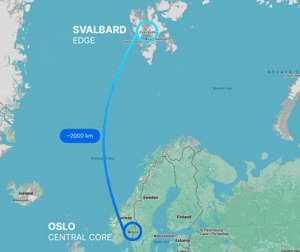
The architecture connected facilities in Fornebu and Svalbard, approximately 2,000 kilometres apart and operating in very different environments.
The objective was to allow the a remote site to operate autonomously when needed, without requiring a fully standalone network during normal operations.



.png?width=300&name=002_25_06_AxyomxRedhat_telenor_linkedIn_v2%20(1).png)
AxyomCore has demonstrated 5G core functions using Red Hat OpenShift on Google Cloud and Amazon Web Services, giving telecommunications service providers flexibility in where and how they deploy the mobile core.
Learn more
Watch our video interview with Telenor and AxyomCore to explore 5G SA use cases and learn how partners like AxyomCore and M-Edge are helping advance connectivity at Telenor Research & Innovation.
Watch video