

This case study highlights how AxyomCore and Deutsche Telekom demonstrated a 5G Wireless-Wireline Convergence use case designed to bring fixed broadband services into the 5G Core. The demonstration featured AxyomCore’s Integrated Access Gateway (AGF) and User Plane Function (UPF) and Deutsche Telekom’s 5G-capable Residential Gateway, showing how operators can deliver fixed broadband services from a 5G Core over an existing fiber access network.
By combining fixed and mobile network capabilities, Wireless-Wireline Convergence gives operators a path to streamline operations, reduce costs and enhance user experiences without requiring forklift upgrades to the access network.
Originally posted by the Broadband Forum, the article below highlights how Wireless-Wireline Convergence is helping operators bring together fixed and mobile network capabilities to improve efficiency, reduce costs, and enhance user experiences without requiring forklift upgrades to the access network.
Broadband Forum Innovation Demonstration
Key Highlights:
-
Broadband Service Delivery with 5G-RG: The demonstration showed the provisioning and the delivery of fixed broadband services from a 5G Core network, supplied by AxyomCore, to a wired 5G-capable Residential Gateway, supplied by Deutsche Telekom, via an unmodified fiber access network.
- Integrated AGF/UPF: The showcase demonstrated an integrated Access Gateway Function (AGF) and 5G Core User Plane Function (UPF), supporting Control User Plane Separation (CUPS), running in a provider cloud or public cloud
- Dynamic Connectivity: While the current demonstration features a static 5G VLAN connection via an access Traffic Steering Function (TSF) to the AGF, future implementations could leverage Subscriber Session Steering to switch 5G customer sessions to the AGF/5G Core, leveraging synergies of evolving standards and capabilities in the fixed access network.
- Smooth migration and co-existence: The demonstration showed how wired 5G-RGs are supported via the 5G core and AGF. At the same time, unmodified/legacy RGs co-exist on the same fiber network in parallel and are steered to a Broadband Network Gateway (BNG).
- Network Streamlining: The 5GC provides the single set of common functions for control, management and service provision, streamlining network operations and reducing total cost of ownership (TCO).
- Enhanced Services: By leveraging the capabilities of the 5G core network, operators can deliver a richer set of features and services to broadband users.
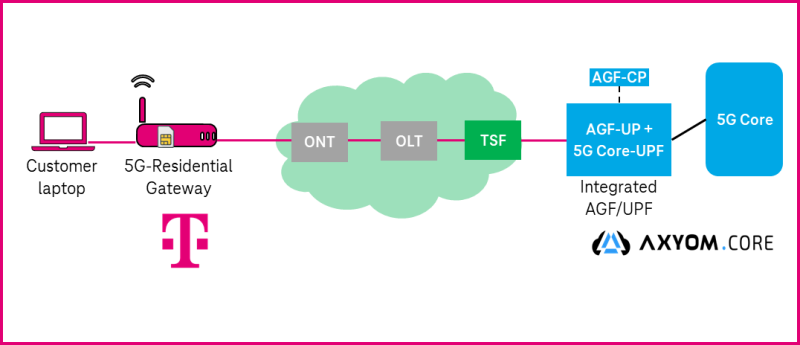
A simplified block diagram of the Broadband Forum’s Wireless Wireline Convergence demonstration at Network X showing a Fixed Network Residential Gateway provisioned via a 5G Core and fed via a fiber network.
Diagram Legend (right to left):
ONT – Optical Network Terminal
OLT – Optical Line Terminal
TSF – Traffic Steering Function
AGF – Access Gateway Function
CP – Control Plane
UP – User Plane
UPF – User Plane Function
Additional Quotes
The successful end-to-end testing demonstrated at Network-X proves that wireline services can leverage a 5G Core and wireless and wireline convergence is real. We are looking forward to new innovative ideas that leverage such an architecture that could benefit both consumers by providing new capabilities and service providers by reducing overall TCO. We now need RG vendors to start developing 5G-RG solutions that could take advantage of this architecture!!
Luis Tomotaki, Verizon, Associate Fellow at Verizon Data Services
Convergence in action! Well done to all BBF members who contributed to these standards and building the demo.
Gavin Young, Vodafone, Head of Fixed Access Centre of Excellence